Freelance Contract Template: 10 Clauses Every Freelancer Needs
The clients who seemed perfectly reasonable at the start of the project is not always the same person you are dealing with at the end of it. A contract is what protects you in the gap.
Quick Summary A freelance contract does not need to be long — it needs to be specific about deliverables, money, revisions, and what happens when things go sideways. The 10 clauses below cover every common freelance dispute before it becomes one. Your contract and invoice should reference each other — an invoice without a contract behind it is a request, not an obligation. GigLedgers lets you generate a free digital contract with e-signatures, synced to your invoices.
Here is a situation every freelancer eventually lives through.
You agreed to design a website. The client now wants an app. And a booking system. And "just one more revision" — their sixth. At no point did anyone say the fee would change.
This is not a bad client story. This is a no-contract story.
A freelance contract is not about distrust. It is about clarity. When both sides agree in writing on what is being delivered, how much it costs, and what happens if anything changes — there is nothing to fight about. The contract has already answered every question before it gets asked.
Here are the 10 clauses that do the work.
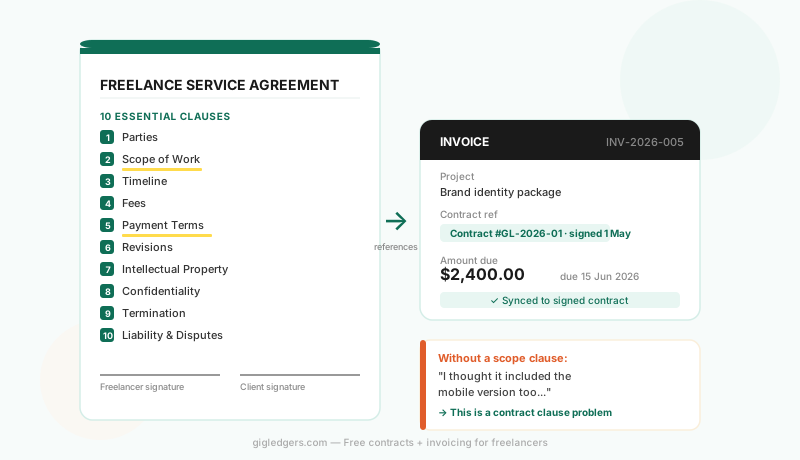
- Parties
Full legal names and contact details of both the freelancer and the client. Use the legal name of the business, not just the first name of your contact. This matters if you ever need to enforce the agreement.
- Scope of Work
The most important clause in the contract. Describe specifically what you will deliver and — just as importantly — what you will not. If it is not listed, it is not included.
Weak scope: Website design and development
Strong scope: Design and front-end development of a 5-page marketing website (Home, About, Services, Blog, Contact). Excludes e-commerce functionality, custom animations, content writing, and SEO setup.
Every vague scope clause is a potential unpaid work request waiting to happen.
- Timeline
Start date, key milestones, and the final delivery date. Crucially, include how long the client has to provide feedback at each stage — "Client will provide written feedback within 5 business days of each deliverable." Without this, a slow client can delay your entire project schedule and it becomes your problem, not theirs.
- Fees
State the total fee, the currency, and whether it is a fixed price, hourly rate, or retainer. Be explicit. "We agreed on $2,000" is not the same as "A fixed fee of CAD $2,000 (two thousand Canadian dollars)." Specify which budget covers what if there are multiple deliverables.
- Payment Terms
This clause connects your contract to your invoices. Cover:
Deposit amount and when it is due (typically before work begins) Milestone payments and what triggers each one Final payment terms and due date Late fee clause: "Invoices unpaid after [X] days accrue a late fee of 1.5% per month on the outstanding balance"
A contract payment schedule makes your invoices easy to approve — the client already agreed to this.
- Revisions and Change Requests
Define how many revision rounds are included in the fee and what counts as a revision versus a new request. A revision is a refinement of what was agreed. A new request is a change to what was agreed — and it requires a new written quote.
Example clause: Two rounds of revisions are included. Each additional revision round will be quoted separately and requires written approval before work begins.
This single clause prevents the vast majority of scope creep disputes.
- Intellectual Property
When does the client own the work? The standard in most freelance contracts is that ownership transfers to the client upon receipt of full payment. Before that point, the work remains yours.
Also clarify what happens to your pre-existing materials — frameworks, code libraries, design systems — that you incorporate into the project. These typically remain licensed rather than sold outright.
- Confidentiality
Both sides agree not to share non-public information about each other's business, clients, or methods. This is usually mutual — you do not share the client's business plans, and the client does not share your proprietary processes or rates.
- Termination
How does either party end the agreement early? A reasonable clause gives both sides a notice period (7 to 14 days is common) and clarifies that work completed up to termination is billable. This protects you from a client who disappears mid-project after receiving your first draft.
Include a kill fee if you want one — a percentage of the remaining project fee that becomes due if the client cancels after a certain point. Standard kill fees range from 25 to 50% of the outstanding balance.
- Liability and Disputes
Cap your liability to the total project fee — you should not be on the hook for a client's business losses if a website launch goes badly. Include a practical dispute resolution process: first good-faith discussion, then mediation if needed, and the governing law (your province or country).
Contract vs invoice: how they work together
A contract records what was agreed. An invoice bills for what was delivered. They should always reference each other.
Every invoice you raise should include the contract number and the milestone it covers: "Invoice for Phase 2 deliverables per Contract #GL-2026-01 signed 1 May 2026." When a client's accounts team can match the invoice to a signed agreement, approval is straightforward.
GigLedgers keeps your contracts and invoices synced automatically — so the connection between agreement and billing is built in, not something you have to manage manually.
Simple contract template outline
Use this as a drafting starting point. Have a lawyer review it for high-value projects or unusual arrangements.
FREELANCE SERVICE AGREEMENT
Parties: [Freelancer name] and [Client name]
Services: [Specific deliverables], excluding [out-of-scope items]
Timeline: Work begins [date]. Milestones: [list]. Client feedback due within [X] business days of each deliverable.
Fees: Fixed fee of [amount and currency], payable as follows:
- [X]% deposit on signing
- [X]% on [milestone]
- [X]% on final delivery
Revisions: [X] rounds included. Additional rounds quoted separately.
Ownership: Full rights transfer to client upon receipt of final payment.
Termination: Either party may terminate with [X] days written notice. Work completed through termination is billable.
Governing Law: [Province/Country]
Signatures: ___________________ Date: ________ ___________________ Date: ________ Frequently Asked Questions
Do I need a contract for small projects?
Yes. A short written agreement is worth doing even for a $200 project. The time it takes to draft is far less than the time you will spend managing a dispute without one.
Are electronic signatures legally valid?
In most Canadian provinces and many countries, yes — electronic signatures are legally binding for most commercial contracts. Validity depends on the specific agreement and jurisdiction. GigLedgers' e-signature tool provides a clear digital record of who signed and when.
Can I reuse the same contract template?
Yes, as a starting point. Update the scope, fees, payment schedule, and IP provisions for every project. Never reuse a template from a different jurisdiction without checking that the governing law clause is correct.
What if the client refuses to sign a contract?
That is information. A client who won't commit in writing before work begins is telling you something about how they will behave when the invoice arrives.
Generate your contract in minutes
Stop sending invoices into a void of verbal agreements. GigLedgers lets you create a professional freelance contract with e-signatures — free, in minutes, synced to your invoices automatically.
👉 Create a free contract on GigLedgers
📚 Related: How to write a freelance invoice that gets you paid faster | Browse all freelance guides
Educational information only. Have a qualified lawyer review agreements when financial or legal stakes are significant.