How to Create a Freelance Invoice in Canada (2026 Guide)
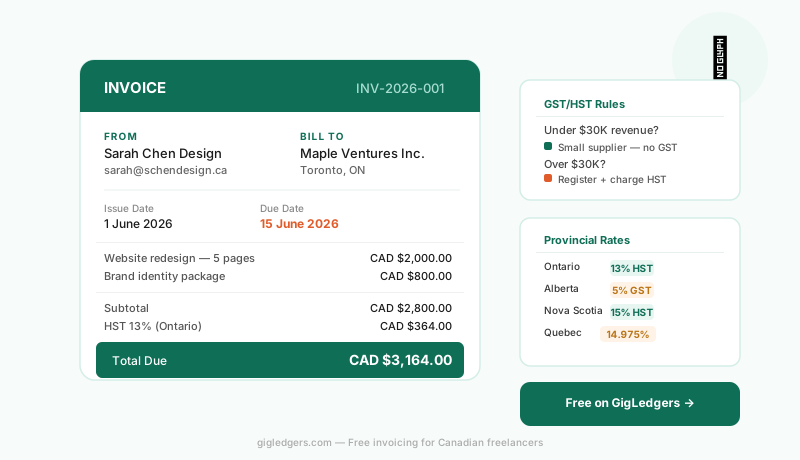
A professional invoice isn't just a payment request. In Canada, it's also a tax document, a paper trail, and your best tool for getting paid on time.
Quick Summary Every Canadian freelance invoice needs your name, client name, invoice number, due date, service description, and payment details. You only charge GST/HST if your taxable revenues exceed CAD $30,000, below that, you are a small supplier and registration is not required. Always write the actual calendar due date, not just "Net 30." Currency matters — specify CAD explicitly, especially when working with US-based clients. GigLedgers is a free invoice generator that handles multi-currency, tax fields, and payment tracking automatically.
You finished the project. The client is happy. Now comes the part that actually puts money in your account.
A lot of Canadian freelancers — especially those just starting out — treat invoicing as an afterthought. They cobble something together in Word, forget to specify the currency, leave off a due date, and then wonder why payment takes three weeks instead of one.
The invoice is where professionalism either shows up or doesn't. A well-built invoice removes every reason for a client to pause, question, or delay. A sloppy one creates those reasons.
Here is everything your Canadian freelance invoice needs — and a few things it definitely doesn't.
What every Canadian freelance invoice must include
Think of this as your checklist before hitting send.
Your name and contact details
Use your legal name if you operate as a sole proprietor, or your registered business name if you have one. Include your email address and phone number. If you have a website, add it — it signals that you are a real, established professional.
Client name and billing address
Address it to the person or company responsible for payment — not just your day-to-day contact. Finance teams need to match invoices to purchase orders, and the wrong name causes delays.
A unique invoice number
Use a simple sequential format like INV-2026-001. GigLedgers auto-generates these so you never have to think about it. What matters is consistency — your client's accounts team will reference this number in every communication about the invoice.
Issue date and due date
Write both. The issue date is when you sent the invoice. The due date is when payment is expected — and write it as an actual calendar date, not just "Net 30." "Due by 15 June 2026" is unambiguous. "Net 30" is open to interpretation.
Service description
This is where most invoices fall short. "Consulting services" or "design work" gives a finance team a reason to pause and ask for clarification. A good description is specific enough that there is nothing left to query.
Instead of: Website development
Write: Front-end development for e-commerce site — product pages, cart and checkout flow — as per project brief dated 1 May 2026
Currency and amounts
Always specify CAD. When Canadian freelancers work with US clients, currency ambiguity is one of the most common sources of payment disputes. Show your subtotal, any applicable tax, and the total amount due as separate line items.
Payment instructions
How do you want to get paid? Bank transfer, e-transfer, Stripe, PayPal? Put the details right on the invoice — in the payment notes section at the bottom. If your client has to email you to find out how to pay, you have already lost a few days.
GST/HST: when do you actually need to charge it?
This is the question most Canadian freelancers get anxious about, and it doesn't need to be complicated.
The $30,000 rule
If your total taxable revenues from your business — across all clients, across the year — do not exceed CAD $30,000, you are considered a small supplier by the Canada Revenue Agency. Small suppliers are not required to register for GST/HST, and you should not charge it on your invoices.
Once you cross that threshold in a single calendar quarter or over four consecutive quarters, registration becomes mandatory and you need to start charging GST/HST.
What if I'm registered?
Determine the right GST/HST rate based on your client's province — it isn't always Ontario's 13% HST. Here is a quick reference:
Province Rate Type Ontario 13% HST British Columbia 12% GST + PST Alberta 5% GST only Quebec 14.975% GST + QST Nova Scotia 15% HST
For clients outside Canada, GST/HST typically does not apply to your services — they are considered exports. Check CRA's export rules for your specific situation.
What goes on a GST/HST invoice?
If you are registered and charging tax, your invoice must also show your GST/HST registration number. The tax amount should appear as a separate line item — not baked into the total.
Payment terms that actually get you paid Net 15 vs Net 30
Net 15 (payment due 15 days after invoice) is generally better for freelancers than Net 30. Shorter terms mean your invoice stays top-of-mind. Net 30 is the corporate default — it suits companies with monthly payment runs, not freelancers with cash flow to manage.
For new clients, start with Net 15. Once a relationship is established you can extend terms if needed.
Deposits and milestones
For projects over CAD $500, ask for a deposit before starting. 30 to 50% upfront is standard and widely accepted. For longer projects, milestone invoicing — billing at defined project stages — protects both sides and keeps cash flowing.
Late fees
A single line in your payment notes changes how clients prioritise your invoice: "A late payment fee of 1.5% per month applies to invoices unpaid after the due date." Most clients will never trigger it. Its presence is the point.
Five mistakes that delay payment
Forgetting to specify CAD. When you have US clients, "500" means different things. Write CAD $500 every time.
No due date. "Upon receipt" and "Net 30" are both vague. Write the date.
Describing work vaguely. "Services rendered" is not a description. It is a reason to ask questions.
Sending it late. Invoice the same day you deliver the work. The longer you wait, the colder the approval process gets.
No payment details on the invoice. Your bank details, e-transfer email, or payment link should be right there, unavoidable.
Frequently Asked Questions
Can I invoice clients without incorporating in Canada?
Yes. Sole proprietors invoice clients under their legal name without needing to incorporate. You may need to register a business name separately, and provincial rules vary.
Should I invoice before or after completing the work?
Both are common. Deposits before starting, milestone invoices during the project, and a final invoice on delivery is the standard freelance structure. What matters most is that payment terms are agreed in writing before work begins.
Do I need accounting software to send invoices?
No. Invoicing and accounting are different tasks. For most freelancers, a dedicated invoice tool is enough until transaction volume grows significantly.
What if my client is in the US — do I charge CAD or USD?
Invoice in whichever currency you both agreed to. If you want to be paid in CAD, invoice in CAD and specify it clearly. If you agreed to USD, invoice in USD and note the equivalent CAD amount for your own records. GigLedgers supports multi-currency invoicing so you can set this per client.
Create your first Canadian invoice in 2 minutes
Stop building invoices in Word. GigLedgers is a free invoice generator that handles sequential numbering, tax fields, multi-currency, due dates, and payment tracking — all without a subscription.
You focus on the work. Let the invoice take care of itself.
👉 Create a free invoice on GigLedgers
📚 Related: How to write a freelance contract that protects you | Browse all freelance guides
This article provides general information, not tax or legal advice. Consult the CRA or a qualified professional for guidance specific to your situation.