How to Get Your First Freelance Client: A 30-Day Action Plan
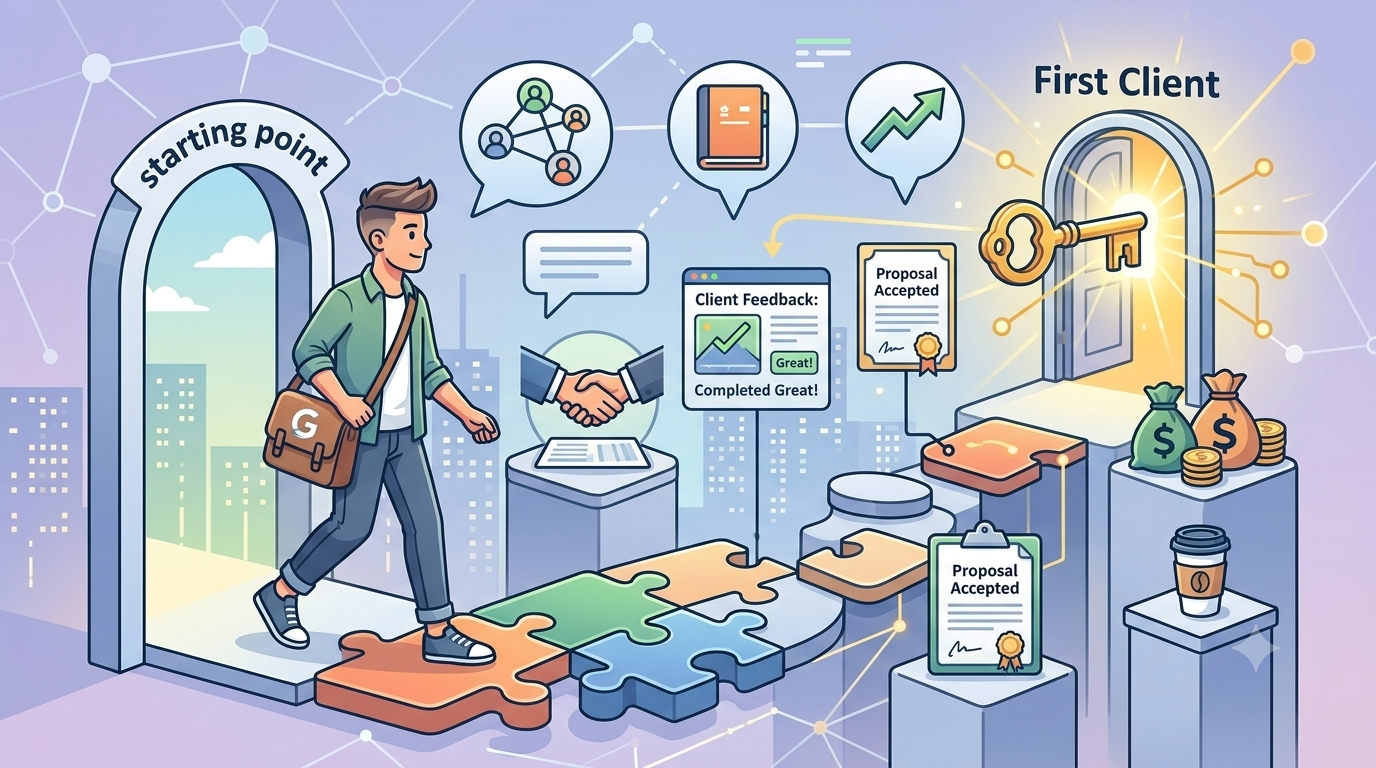
Your first freelance client doesn't care about your brand colours, your logo, or whether your portfolio website is live. They care about one thing: can you solve the specific problem they have right now?
Quick Summary Pick one service for one type of client. Generalists struggle to get their first client because "I do everything" is hard to hire for. Build 2 to 3 samples before you have clients — clearly labelled as self-initiated work. Do 20 to 30 personalised outreach messages in Week 3. Not a mass email. Personalised. When you land the first project, protect it with a written agreement and send a professional invoice. Your first impression as a business owner matters. GigLedgers is a free tool for your first contract and first invoice — so you look like you've done this before, even if you haven't.
The most common reason people don't get their first freelance client is not a weak portfolio. It is not the wrong platform. It is not bad luck.
It is a vague offer sent to no one in particular.
"I'm a designer available for freelance work" is not an offer. It is a broadcast into the void. The people you want to hire you are not searching for "a designer available for work." They are searching for someone who can solve the specific problem they have today.
The 30-day plan below is built around this insight. Every week has one job.
Week 1: Get specific about what you offer and who you offer it to
Resist the instinct to offer everything. You will get your first client faster with a narrow, specific offer than a broad, "I do anything" pitch.
Write one sentence using this structure: "I help [specific type of client] achieve [specific result] through [specific service]."
Some examples that work:
"I help early-stage startups launch faster by designing clear, conversion-focused landing pages." "I help independent restaurants attract more bookings through short-form video content for Instagram." "I help consultants save 5 hours a week by automating their reporting with Google Sheets." "I help student-founded businesses look credible with professional brand identity design."
This sentence becomes your outreach opener, your portfolio headline, and your answer when someone asks what you do.
Week 2: Build proof before you need it
You do not need client work to build a portfolio. You need demonstrations that you can deliver what you say you can.
Create 2 to 3 sample projects. These can be redesigns of real businesses (labelled clearly as unsolicited concept work), original projects you initiate yourself, or work from student projects or internships. What matters is that they show your thinking, your process, and your output.
Your portfolio does not need to be a website. A well-organised PDF, a Notion page, or a Behance profile is enough to start. It needs to answer three questions clearly:
What do you do? Who is it for? What does the result look like?
One thing to never do: imply a sample was commissioned by a real client when it wasn't. Fabricated testimonials or fake case studies will destroy trust the moment a client asks follow-up questions.
Week 3: Do the outreach most people skip
Most freelancers post on LinkedIn that they're available and wait. That is not outreach. That is hoping.
Real outreach is personalised, specific, and offers something of value before asking for anything.
Build a list of 30 relevant prospects. This could be founders in a local startup community, small businesses in your area, campus organisations, independent professionals in your network, or businesses whose social media you have noticed could be better.
For each prospect, write a message that references something specific about their situation.
Example outreach message:
Hi [Name], I noticed your bakery's Instagram has great photos but hasn't posted Reels yet — that format is driving most of the organic reach for local food businesses right now. I create short-form video content for independent food businesses and have a few ideas that might work well for you. Would it be useful if I sent over a quick concept?
This message has three things: a specific observation, a clear credential, and a low-stakes next step. It is not asking for a project. It is asking for a conversation.
Send 20 to 30 of these. Not all at once — spread them over the week. Respond to every reply within a few hours.
Week 4: Turn interest into a paid first project
When someone expresses interest, the instinct is to send a long proposal and then wait. Instead, offer a small, clearly defined pilot project — something with a fixed price, a defined deliverable, and a short timeline.
A pilot project does several things: it lowers the client's risk, it gets you paid faster, and it gives you something real to add to your portfolio.
Before starting any work — even a small project — agree on these five things in writing:
Exactly what will be delivered and what is excluded The total price, currency, and payment terms The timeline and when client feedback is due How many revision rounds are included Who owns the final work
Put this in a simple written agreement. Then send a professional invoice when payment is due.
This is not bureaucracy. It is how you signal that you are a professional who does this properly — which, especially for a first client, sets the tone for everything that follows.
30-day scorecard Activity Target Specific offer defined 1 Portfolio samples created 2 to 3 Relevant prospects researched 30 Personalised outreach messages sent 20 Discovery conversations 3 to 5 Written agreements signed 1 First invoice sent 1
These are action targets, not conversion guarantees. Thirty messages will not always produce five conversations. But zero messages will produce zero conversations every time.
Frequently Asked Questions
Can I freelance while studying?
Yes, in most cases. Check your institution's policies, and if you are on a student visa, review what your visa permits regarding work. Set project deadlines with your academic schedule in mind — the fastest way to lose a first client is to miss a deadline.
Should my first project be free?
Not as a rule. A tightly scoped paid pilot tests demand better than unpaid work. If you choose to do pro bono work for a charity or friend, define scope and deliverables just as carefully — scope creep on free work is more demoralising than on paid work.
Do I really need a contract for a small first project?
Yes. A short written agreement is worth doing from day one, even for a small project. It sets a professional tone, protects both sides, and makes your invoice straightforward to approve because the client already agreed to the terms.
What if no one responds to my outreach?
Revisit the specificity of your offer and the relevance of your prospect list. If your outreach is genuinely personalised and your samples are strong, low response rates usually mean targeting, not quality. Try a different type of client or a different channel.
Your first invoice matters more than you think
When your first client is ready to pay, how you handle that moment shapes how they think about working with you again.
A professional invoice with a clear description, a real due date, your payment details, and a reference to your signed agreement is not just a billing document — it is evidence that working with you is straightforward and organised.
GigLedgers gives you free contract generation and invoicing from your very first client. No subscription, no learning curve, no fumbling with Word templates.
👉 Create your first contract and invoice free on GigLedgers
📚 Related: How to write a freelance invoice that gets you paid faster | Freelance contract essentials | Browse all guides
This guide is educational and does not guarantee client acquisition. Results depend on your specific skills, market, and execution.